On August 5, 2010, the collapse of a mine in the Atacama Desert, northern Chile, triggered one of the most dramatic and emblematic episodes in the history of modern mining. The San José mine, which extracted gold and copper, caved in, trapping 33 miners approximately 700 metres underground in extreme conditions, with no communication to the surface and under constant risk of further cave-ins.
By desierto_atacama - Mina San Josè Uploaded by Diego Grez, CC BY-SA 2.0
For the first 17 days, there was no certainty about the group’s survival. The only hope lay in the drilling operations attempting to locate the emergency shelter where the workers might have taken refuge.
It was at this critical moment that history took its first turn: one of the search drills reached the chamber. When pulled back to the surface, it carried a small message, written in red ink and taped on:
“Estamos bien en el refugio, los 33” (“We are well in the shelter, the 33”)
By Gobierno de Chile - Presidente de la República en Mina San José, CC BY 2.0
The phrase spread worldwide. It was the sign that all were alive. At the same time, however, it meant the true challenge was only beginning: how to rescue 33 people trapped at such depth?
The Chilean government, with support from international experts, outlined three parallel strategies to try to reach the miners safely. Plans A, B, and C were born:
Plan A: used the mine’s existing infrastructure to attempt an escape tunnel, but it was slow and unstable.
Plan B: relied on an angled drill rig, which was faster but carried a high structural risk.
Plan C: the boldest and most direct. It involved drilling vertically from the surface to the miners’ shelter, using oilfield equipment operated by the Canadian company Precision Drilling Corporation
The equipment used, known as Rig 421, had been developed for deep oil exploration. Its use in a human rescue mission was unprecedented. The rig’s robustness and stability, however, proved decisive for the operation’s success.
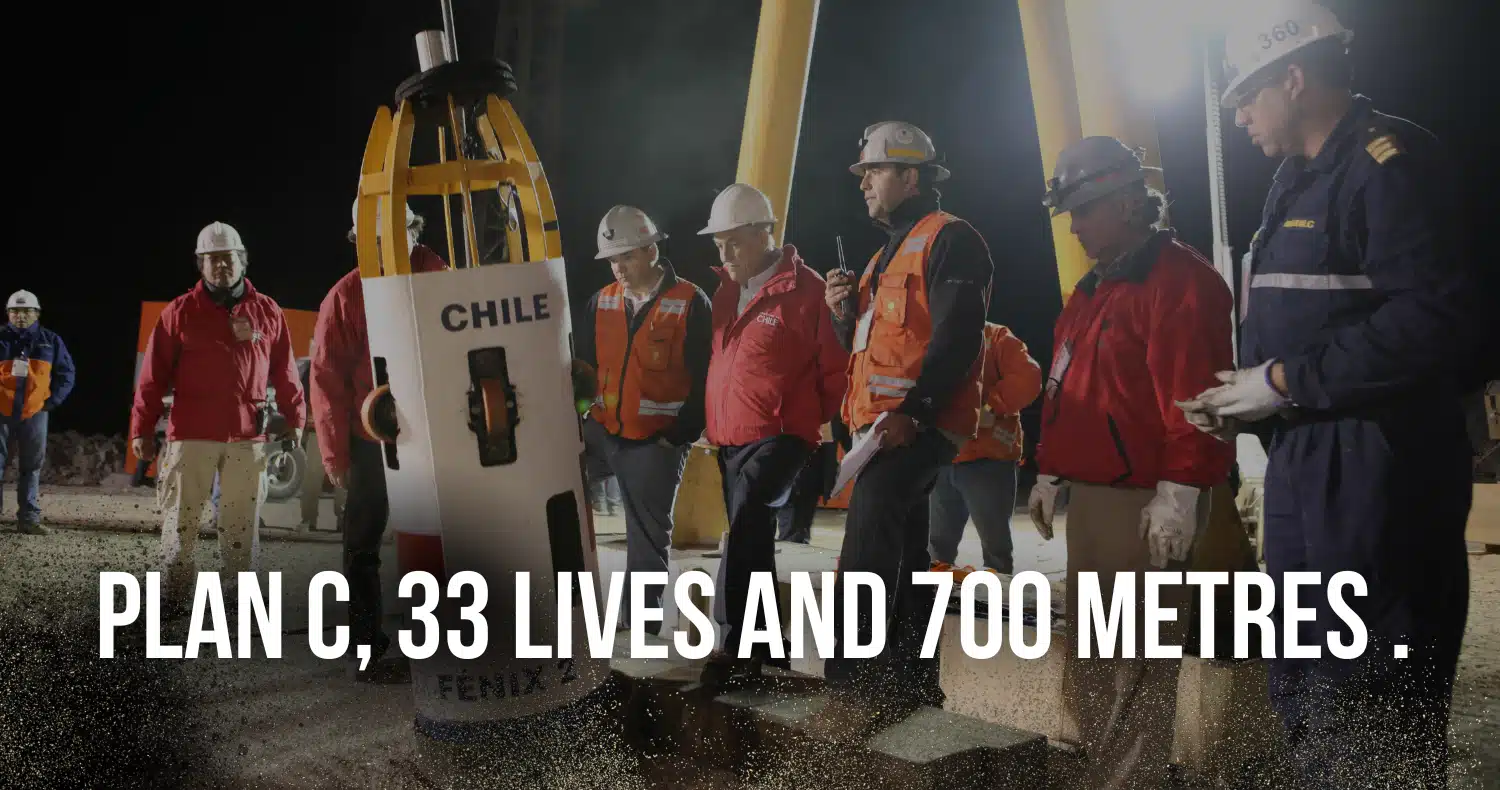
After weeks of delicate technical work, with support from NASA, the Chilean Navy, and engineers from various countries, Plan C’s vertical shaft reached the refuge chamber on October 9. From that point, it became possible to install the specially designed Fénix 2 capsule, built to travel safely up and down the shaft, lifting each miner to the surface.
By Gobierno de Chile - originally posted to Flickr as 12.10.10 Primera prueba de la cápsula, CC BY 2.0
The rescue began on October 12 and continued overnight into the following day. One by one, the 33 workers were brought up. Some smiled, others wept, but all returned to the surface alive after 69 days underground.
The world witnessed an achievement that combined technology, strategy, and international cooperation.
By Gobierno de Chile - 13.10.10 Edison Peña, CC BY 2.0
The Legacy of Plan C
The success of Plan C demonstrated something fundamental: in high-risk operations, having alternatives is essential. The decision to use an oil drilling rig, even though unconventional, was the technical factor that saved lives. The precision of Rig 421, combined with joint planning, made possible what many had considered improbable.
Engineers, technicians, miners, managers, members of the armed forces, and scientists from various countries stood united under one mission: to save lives.
The rescue of the Chilean miners was a powerful demonstration of what can be accomplished when knowledge, courage, and cooperation work hand in hand.
Above all, this story is an example of how technology, when applied with boldness and responsibility, can surpass its own limits. Our admiration goes to all those involved.
Hugo Infante/Government of Chile, CC BY 2.0
References
DMT Group. The Rescue of the 33 Chilean Miners: A Story of Courage and Triumph. Available at: https://www.dmt-group.com.br/en/blog/mining/details/article/the-rescue-of-the-33-chilean-miners-a-story-of-courage-and-triumph. Accessed August 2025.
Wikipedia. 2010 Copiapó mining accident. Available at: https://en.wikipedia.org/wiki/2010_Copiap%C3%B3_mining_accident. Accessed August 2025.
Wikipedia. Fénix capsules. Available at: https://en.wikipedia.org/wiki/F%C3%A9nix_capsules. Accessed August 2025.
NPR. The Incredible Story Of Chilean Miners Rescued From The ‘Deep Down Dark’. Available at: https://www.npr.org/2014/10/29/359839104/the-incredible-story-of-chilean-miners-rescued-from-the-deep-down-dark. Accessed August 2025.
Smithsonian Magazine. The Capsule That Saved the Chilean Miners. Available at: https://www.smithsonianmag.com/innovation/the-capsule-that-saved-the-chilean-miners-5620851. Accessed August 2025.
Wikipedia. The 33 (film). Available at: https://en.wikipedia.org/wiki/The_33. Accessed August 2025.
HBS Alumni Bulletin. Crisis Management: Chilean Mine Rescue Case Summary. Available at: https://www.alumni.hbs.edu/Documents/events/HBS-ALUMNI-Crisis-Mgmt_5_Chilean-Mining-Rescue-and-Summary.pdf. Accessed August 2025.
The use of wooden boxes for transporting and storing diamond core samples created a number of difficulties, which were common to many companies in the mining industry. Core Case developed new products for this task, which offered a new alternative to the market, that solves these issues and brings other benefits. Core Case’s boxes and accessories are produced in 100% recycled and recyclable plastic (Polypropylene – PP). They have an ergonomic design. They are tough, light and easy to carry. In fact, they are more durable than boxes made of wood or other materials.


.jpg)

