Arquivos MINING - Core Case

MINING

ISO 14001 at Core Case: 16 years of practice, now with international certification

The achievement came on May 17, 2026, the first day of the XII SIMEXMIN, in Ouro Preto.
 
When Core Case was founded in 2010, choosing recycled polypropylene over wood was already a public decision. For sixteen years, that choice has guided every box manufactured, every partnership, and every square centimeter of the operation. On May 17, 2026, the first day of the XII SIMEXMIN in Ouro Preto, that commitment earned formal recognition from one of the most respected certifications in the world for environmental management: ISO 14001.

What ISO 14001 is

ISO 14001 is the international standard that defines the requirements for an Environmental Management System. Published by the International Organization for Standardization (ISO) and updated in 2015, it is the global benchmark for systematized environmental management. The standard requires an organization to identify its environmental impacts, plan concrete actions to reduce them, monitor the results, and continuously improve the process.

Rather than a one-time certificate, ISO 14001 attests to a living, auditable, and demanding system, with accountability from leadership and the entire value chain held to the same criteria. It is widely required across supply chains in sectors such as mining, energy, heavy industry, and infrastructure.

Why the certification matters for Core Case

For Core Case, ISO 14001 was not a starting point. It was the recognition of a journey. The certification confirms, under internationally recognized external audit, that the brand’s way of operating, built since 2010, meets the most demanding environmental management requirements in the world.

In practice, ISO 14001 brings even more structure to how that environmental commitment translates into every process of the company: from manufacturing to transport, from supplier selection to partnerships with mining companies. Every stage now falls under a system of continuous measurement, with targets, indicators, and periodic audits.

And it positions Core Case as part of the transformation the global mining industry is living today: the transition toward an industry that does not simply extract, but extracts responsibly.

Why the certification matters for Core Case clients

When a mining company chooses Core Case as a supplier of core storage solutions, it gains a link in the chain that holds the same international standard the company itself must meet.

This makes environmental compliance easier in tenders and contracts, strengthens the mining company’s own ESG reporting, meets audit requirements from stakeholders and investors, and reduces reputational risk across the supply chain. In a sector where every link in the chain counts toward the final client’s sustainability report, having an ISO 14001 supplier is an operational and financial advantage.

And it signals something important to everyone in the field: the box carrying the core sample was produced under a management system that respects the same planet its operation explores.

ESG from the beginning. Now, certified.

ISO 14001 is not the end. It is the recognition of a sixteen-year journey and the starting point for the next stage. Core Case continues developing materials, expanding international partnerships, and investing in technologies such as the Smart Case, with RFID traceability. Always within the same principle that has driven the brand since 2010: a product that respects those in the field and respects the place the operation extracts from.

ISO 14001 at Core Case: 16 years of practice, now with international certification Read More »

PDAC 2026: When Nostalgia Meets the Future of Mining in Toronto

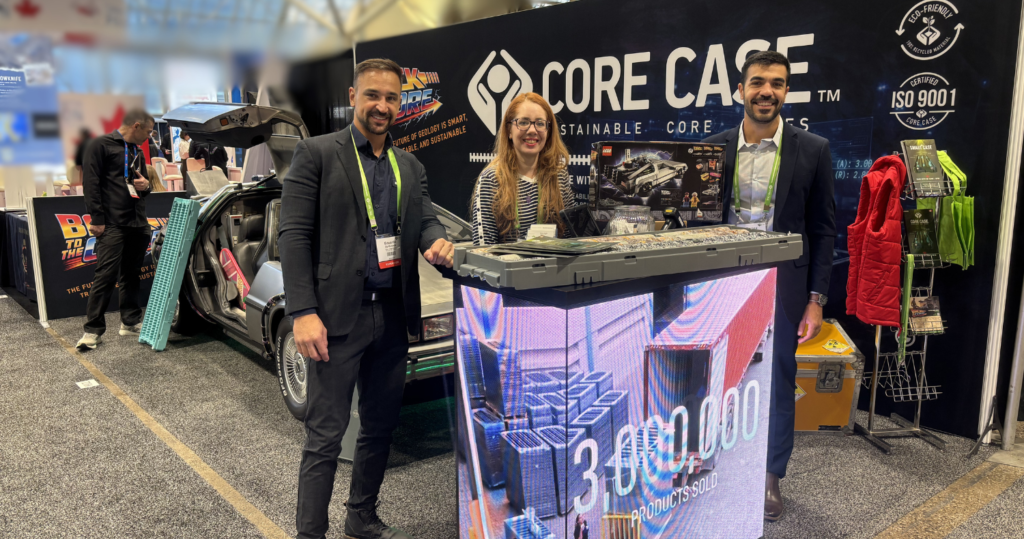
PDAC 2026 welcomed 32,155 participants from around the world, marking the highest participation in the event’s history. Amidst this record-breaking global audience, Core Case established its presence with two strategic booths, capturing the attention of the Metro Toronto Convention Centre (MTCC) with a presence that combined digital technology, nostalgia, and rugged engineering.


Check out the details of our journey across the two pavilions:

North Building: The “BACK TO THE CORE” Phenomenon and Connection to the Future.

In the North Building, nostalgia took centre stage in our BACK TO THE CORE campaign. The iconic DeLorean DMC-12 attracted visitors of all ages and nationalities, drawn by memories of an era that envisioned the future. The car served as more than an exhibit—it became a bridge connecting geologists, executives, and students to Core Case’s mission.
This emotional connection opened the door to meaningful conversations about the technological reality that Core Case already delivers today. We demonstrated how Smart Case transforms drill core sample storage into an intelligent, digital process. With integrated QR Code and RFID technology, our core boxes enable total control from extraction through to the core library, eliminating manual errors, ensuring data security, and guaranteeing full traceability. Manufactured from 100% recycled plastic, these solutions prove that operational efficiency and ESG commitment are inseparable realities in modern mining.
The video connects with Back to the Future, telling the story of a boy who watched his father work tirelessly with Wooden Core Boxes near the drilling site. Inspired by what he saw every day, he imagined stepping into the car of the future to transform drill core sample storage forever. That vision became reality: he became a geologist and brought the world’s most advanced and sustainable core box solution to life.
South Building: ABITIBI Series — Raw Power for Real Field Challenges
While the North Building vibrated with nostalgia and digital innovation, our booth in the South Building commanded respect with the raw engineering of the ABITIBI Series. If the North Building represented connection, the South emphasized durability and resistance for the planet’s most extreme drilling operations.
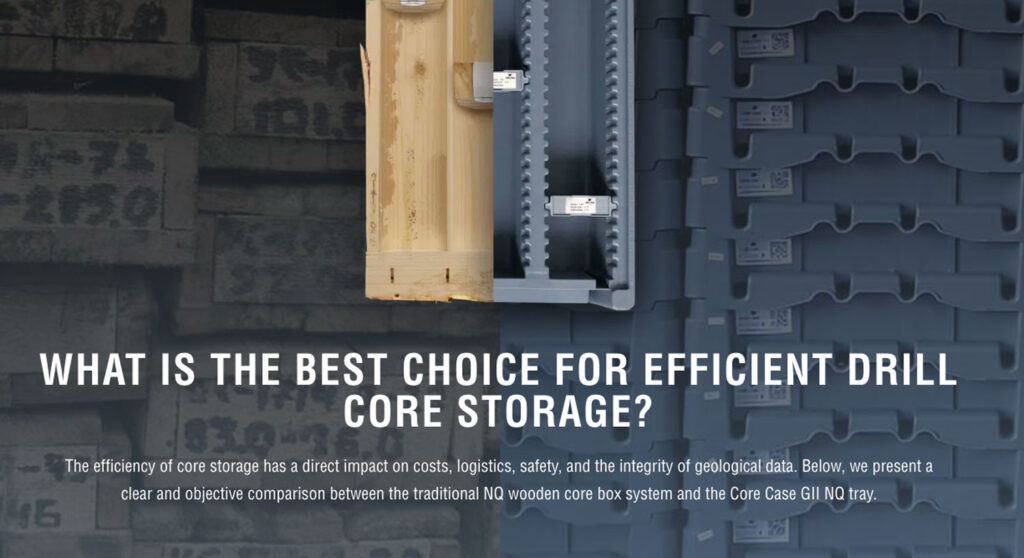
We presented the ABITIBI Series — named in tribute to Canada’s Abitibi Greenstone Belt — as our definitive answer for those operating in inhospitable environments. Engineered for unwavering robustness, it withstands thermal variations from -40°C* to +50°C, guaranteeing the integrity of drill core samples where wood fails. The ABITIBI surpasses traditional Wooden Core Boxes with technical superiority, which suffer from moisture and accelerated degradation in severe climates. Even with its focus on extreme resistance, the ABITIBI maintains Core Case’s technological DNA, remaining fully compatible with the Smart Case system to ensure that physical durability is matched by full traceability.
About SMART CASE
Both spaces showcased the Smart Case GII: in the South with the ABITIBI Series — Core Case’s most resistant core box — and in the North with the GII Smart Case. All Core Case core boxes can be upgraded into a Smart Case, delivering full drill core sample traceability.
Core Case’s Legacy at PDAC 2026
Our participation in Toronto demonstrated that the future of mining demands solutions that are both intelligent and resilient. Whether through emotional and digital connection in the North Building or by overcoming geographical limits with ABITIBI in the South Building, Core Case continues to lead the sector’s transformation with technology, durability, and ergonomics.
 
Driven by the dedication and technical expertise of our team, Core Case achieved success at PDAC 2026. Partners and visitors from around the globe were welcomed. In the North Building, Vanessa, Marcéu, and Eduardo led the BACK TO THE CORE experience. 
Eduardo Rosário, Vanessa Engelke and Marcéu Barreto
In the South Building, Adriano Schwab and Kevin Palmer led demonstrations of the ABITIBI Series, detailing the technical performance of the Generation II line in the harshest environments. 
Adriano Schwab
Kevin Palmer, Daniel Bortowski, Flávio Ramos and Eduardo Rosário
The operation was guided by the strategic leadership of Core Case founders, Flávio and Daniel, who moved between both halls, reinforcing the executive team’s commitment to innovation and direct engagement with the global market.
Daniel Bortowski and Flávio Ramos
We thank each of them for sharing their expertise and for excellently representing the Core Case mission in Toronto.
We appreciate all partners and visitors who made our booths among the most talked-about highlights of the event. The future of drill core sample storage is here and it delivers real advantages for geologists across the industry.

*Note: We expose our trays to temperatures from -40ºC* to +50ºC for 24 hours. –40°C performance validation program in progress.

PDAC 2026: When Nostalgia Meets the Future of Mining in Toronto Read More »

Core box lids: the 1:15 ratio (up to 15x fewer lids) that simplifies drill core logistics

In Canada, many drilling operations still rely on wooden core boxes to store and ship drill core samples. That setup carries an often-overlooked cost driver: the lid. In the traditional model, crews typically work with a strict rule—one box requires one lid to keep ground and air transport secure. In other words, a 1:1 ratio. The outcome stays simple and expensive: as your box count grows, your lid count grows with it. You buy more lids, you store more lids, you handle more lids, and you ship more lids. Lids take up space, add weight, and increase operational complexity.

The issue isn’t “having a lid.” The issue is how the industry has gotten used to using the lid: in practice, it ends up behaving like a “second core box” inside the logistics flow. In Canada, wooden core boxes make this especially clear. To keep ground and air transport secure, many operations work with a strict 1:1 ratio — one lid per box — and that “lid” often functions like another box, which doubles shipped volume and the number of items teams must manage. To keep everything closed in transit, a common workaround is using a strap. It holds, but it adds steps, increases handling, and doesn’t always improve the experience once the box reaches inspection. In the end, what should be a direct process — close, ship, open, and analyze — becomes a sequence of adjustments, strapping, checks, and rework. And the critical point remains the same: teams need to remove the lid easily when they analyze samples later in the warehouse, without relying on improvised fixes that slow the workflow. As a result, the lid stops being simple protection and becomes a second inventory item, increasing material needs and storage footprint. In volume-driven operations — especially across long distances — that creates a compounding effect: more lids mean more shipped volume, more idle space, and more handling.

Core Case changes the logic by keeping the lid in its proper role: a cover—never a box. That approach lets you operate with a smarter standard: one lid for every 15 boxes. When you move from 1:1 to 1:15, you use up to 15x fewer lids for the same number of boxes. In percentage terms, that shift cuts lid requirements by about 93.33% (because 1 − (1/15) = 14/15 ≈ 0,9333 = 93,33%), when your operation can apply that ratio.

Even if you keep the same number of boxes, you eliminate the “extra” built into the system: lid volume drops sharply. That’s where efficiency becomes tangible. You coordinate fewer items, you take up less space, and you reduce handling across the workflow. In the end, you reduce steps, save time, and lower the chance of process failures—without changing what truly matters in the field: protecting the drill core samples, maintaining organization, and preserving transport integrity.

Every operation has its own math—routes, shipping frequency, how many boxes stay in rotation, the flow between field and base, and internal storage standards. That’s why you get the best outcome when you treat the ratio as a logistics design lever, not a generic number.  can help you model your operation with real inputs, define how many lids you actually need, and quantify the impact on volume, complexity, and cost when you move away from the traditional model.

Want us to calculate this for your operation? Contact Core Case.

Core box lids: the 1:15 ratio (up to 15x fewer lids) that simplifies drill core logistics Read More »

2026: Forests or Wooden Core Boxes?

This image hurts, and it needs to hurt.

On one side, life pulsates. A complete ecosystem, with trees that took decades to grow, serving as home to countless species. On the other side, the cold and silent result of a choice: piles of wood and an emptiness where a forest once stood.

When we talk about replacing Wooden Core Boxes with sustainable solutions, we are not talking about a “green marketing gimmick” or a passing trend. We are talking about the image above. About trees on the ground, animals without habitat, and the burden of an industry that, in the middle of 2025, still treats forests as disposable raw material.

Drilling mining, by its nature, already carries an immense environmental liability. It is an impactful activity, and everyone in the sector knows it. That is precisely why the ESG (Environmental, Social, and Governance) agenda has become a pillar of survival, reputation, and long-term viability.

So, how can we justify investing millions in impact mitigation technologies and sustainability reports while continuing to use the most archaic and destructive method for a task as fundamental as storing drill core samples? Continuing to use Wooden Core Boxes in 2026 is deliberately choosing to maintain a problem that already has a superior, more innovative, and, above all, more responsible solution.

It is closing your eyes to the image that hurts.

The future (present) of storage is recycled, resistant, and smart.

The answer to this dilemma is not a distant promise. It already exists and is transforming the operation of companies that have decided to look to the future.

Core Case was born out of unease: it was unacceptable that the Drilling mining industry, so focused on data and geology, depended on a fragile material, susceptible to pests and humidity, and which, in essence, represents the destruction of biomes.

Our core boxes are produced with 100% recycled polypropylene (PP). This means that:

  • No new trees are cut down. We reuse materials already in the production cycle, reducing pressure on natural resources.
  • Durability is incomparable. Our core boxes resist humidity, temperature variations, and impacts, protecting the drill core samples, the most valuable asset of the Drilling mining, for much longer.
  • Operational efficiency increases. They are lighter, easier to handle, and safely stackable, optimizing space and logistics.

In 2025 alone, the adoption of Core Case solutions prevented the equivalent of 16,000 trees from being cut down. Think about it, these are hectares of forest that remain standing, harbouring life, because companies decided to evolve.

The choice is yours, and the future is watching.

 If your operation still uses Wooden Core Boxes, the question that remains is, as painful as it is, simple: Does it make sense to cut down a forest to store rock fragments?

In an era when every corporate decision is meticulously analyzed by investors, clients, and society, continuing to use Wooden Core Boxes is a stain on ESG credibility. It is pretending that a critical part of the problem, that of your own operation, does not exist.

2026 is just around the corner and represents a new cycle of goals, demands, and responsibilities.

The final question is not whether your company will stop using Wooden Core Boxes, but when it will. And if the answer is not “now,” you will be consciously choosing the side of destruction in the image that hurts so much.

Core Case is ready to move your company to the side of the standing forest. Please speak with one of our specialists and lead the transformation.

2026: Forests or Wooden Core Boxes? Read More »

A 290-Million-Year-Old Footprint

Along the shores of Hillsborough Bay in Prince Edward Island (PEI), a footprint broke the silence of the rocks. Not just any footprint, but a trace left roughly 290 million years ago by an ancient inhabitant of the planet. The fossil, measuring about 25 centimetres across, was discovered by Patrick Brunet, a resident and self-taught researcher, and it drew immediate attention from scientists around the world.

Source: Government of Prince Edward Island — article published on October 23, 2025.

Specialists believe the track may have been left by a pareiasaur, an enormous prehistoric herbivore that lived when all continents formed the supercontinent Pangaea. Formal confirmation is still underway, led by an international team that is studying the footprint’s morphology and the rock’s composition in detail.

Source: Government of Prince Edward Island — article published on October 23, 2025.

At that time, PEI’s landscapes were very different from what we see today. Broad flooded plains, seasonal rivers, and a hot, humid climate favoured the accumulation of sediments that, over time, became the reddish rocks that now define the Island. These formations from the Permian Period make Prince Edward Island one of Canada’s most important sites for studying the transition from aquatic to terrestrial life. Each new find reinforces the region’s scientific value, rivalling classic fossil localities in the southwestern United States and in Europe.

Image: Prince Edward Island topographic map-blank.svg. Author: Flappiefh. Source: Wikimedia Commons. License: CC BY-SA 3.0.

For Core Case, which operates a facility in Summerside (PEI), it is a privilege to be in a region that preserves so much of Earth’s history. Every rock, layer, and record reminds us why geology fascinates us and why understanding the past is essential for building the future. We develop solutions that help preserve, organize and make sense of drill core from the subsurface, connecting science and innovation.

Our team is proud to be part of this Island that brings together history, research and community.

References

  1. Government of Prince Edward Island. Large fossil footprint found in PEI. (Oct. 23, 2025). Available at: princeedwardisland.ca
  2. Wikipedia. Geology of Prince Edward Island. (Accessed Oct. 2025). Available at: en.wikipedia.org/wiki/Prince_Edward_Island
The use of wooden boxes for transporting and storing diamond core samples created a number of difficulties, which were common to many companies in the mining industry. Core Case developed new products for this task, which offered a new alternative to the market, that solves these issues and brings other benefits. Core Case’s boxes and accessories are produced in 100% recycled and recyclable plastic (Polypropylene – PP). They have an ergonomic design. They are tough, light and easy to carry. In fact, they are more durable than boxes made of wood or other materials.

A 290-Million-Year-Old Footprint Read More »
Core Shock: Organization and Precision in Every Interval

Core Shock is Core Case’s exclusive system for interval separation in drill core samples. Developed with durable materials, it ensures quick, secure, and intuitive placement—eliminating the use of wooden blocks and improvised solutions once and for all.

Traditional wooden blocks used as depth markers present a critical issue: over time, they can rot, wear down, and lose legibility. This deterioration compromises the reliability of records and puts the accuracy of drilling data at risk. Core Shock addresses this weakness by providing separators made from the same resilient material as our core boxes, ensuring durability and data security under any field condition.

Each separator can be marked manually with permanent markers such as our Core Marker or directly printed using Core Case Tech.

These features, designed by Core Case, allow data to be recorded clearly and permanently, ensuring standardization, traceability, and preventing the loss of essential information over time.

Available in versions tailored to every type of core box, Core Shock maintains data stability and organization throughout the workflow, providing greater reliability for geologists and field teams.

Core Shock is efficiency applied to drilling, preserving information, standardizing operations, and achieving safer results.

Core Shock: Organization and Precision in Every Interval Read More »

The Rescue of the 33 Miners in Chile: How a Canadian Drill Became a Symbol of Salvation

On August 5, 2010, the collapse of a mine in the Atacama Desert, northern Chile, triggered one of the most dramatic and emblematic episodes in the history of modern mining. The San José mine, which extracted gold and copper, caved in, trapping 33 miners approximately 700 metres underground in extreme conditions, with no communication to the surface and under constant risk of further cave-ins.

By desierto_atacama - Mina San Josè Uploaded by Diego Grez, CC BY-SA 2.0

For the first 17 days, there was no certainty about the group’s survival. The only hope lay in the drilling operations attempting to locate the emergency shelter where the workers might have taken refuge.

It was at this critical moment that history took its first turn: one of the search drills reached the chamber. When pulled back to the surface, it carried a small message, written in red ink and taped on:

“Estamos bien en el refugio, los 33” (“We are well in the shelter, the 33”)

By Gobierno de Chile - Presidente de la República en Mina San José, CC BY 2.0

The phrase spread worldwide. It was the sign that all were alive. At the same time, however, it meant the true challenge was only beginning: how to rescue 33 people trapped at such depth?

The Chilean government, with support from international experts, outlined three parallel strategies to try to reach the miners safely. Plans A, B, and C were born:

  • Plan A: used the mine’s existing infrastructure to attempt an escape tunnel, but it was slow and unstable.
  • Plan B: relied on an angled drill rig, which was faster but carried a high structural risk.
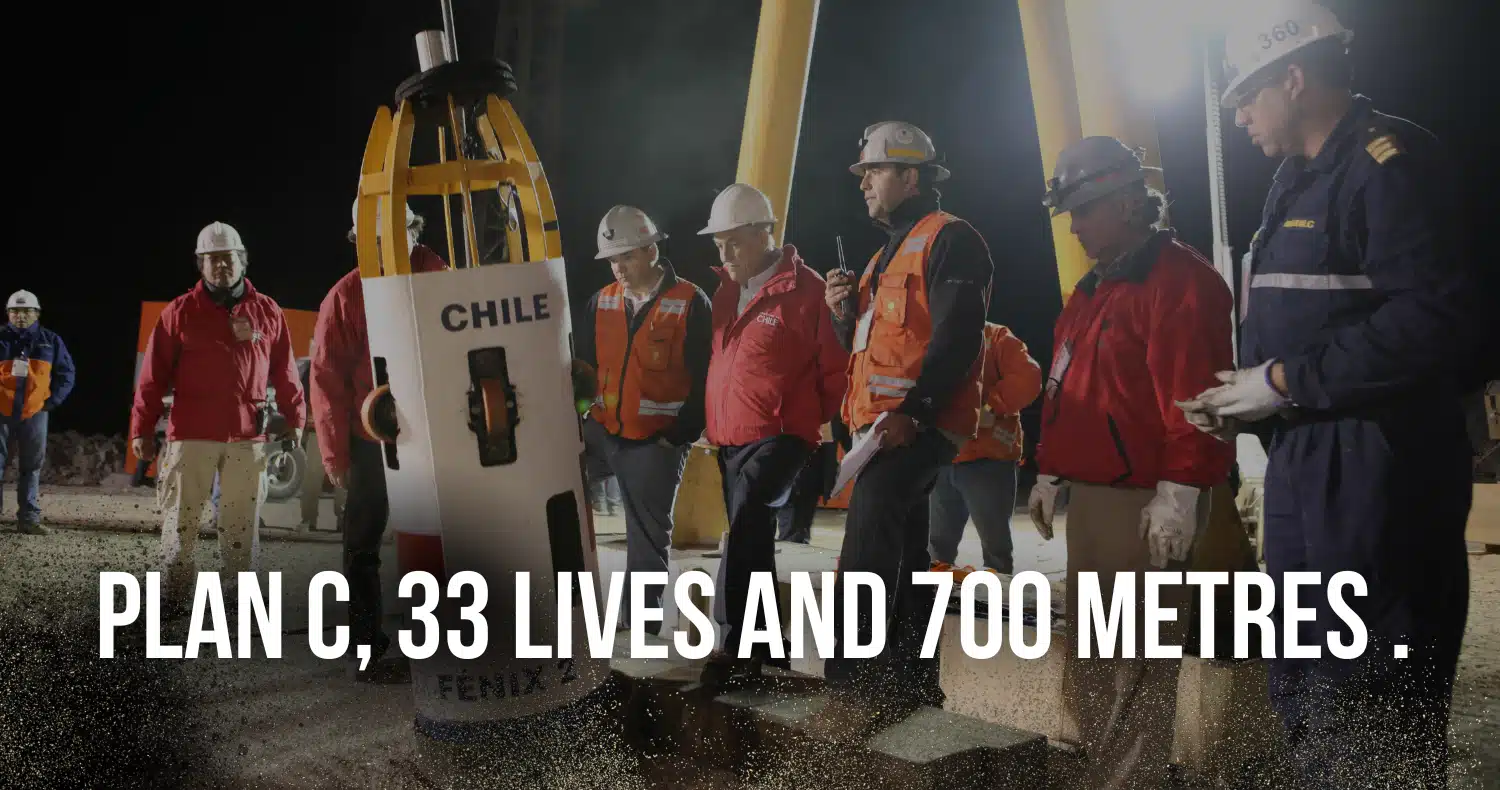
  • Plan C: the boldest and most direct. It involved drilling vertically from the surface to the miners’ shelter, using oilfield equipment operated by the Canadian company Precision Drilling Corporation

The equipment used, known as Rig 421, had been developed for deep oil exploration. Its use in a human rescue mission was unprecedented. The rig’s robustness and stability, however, proved decisive for the operation’s success.

After weeks of delicate technical work, with support from NASA, the Chilean Navy, and engineers from various countries, Plan C’s vertical shaft reached the refuge chamber on October 9. From that point, it became possible to install the specially designed Fénix 2 capsule, built to travel safely up and down the shaft, lifting each miner to the surface.

By Gobierno de Chile - originally posted to Flickr as 12.10.10 Primera prueba de la cápsula, CC BY 2.0

The rescue began on October 12 and continued overnight into the following day. One by one, the 33 workers were brought up. Some smiled, others wept, but all returned to the surface alive after 69 days underground.

The world witnessed an achievement that combined technology, strategy, and international cooperation.

By Gobierno de Chile - 13.10.10 Edison Peña, CC BY 2.0

The Legacy of Plan C

The success of Plan C demonstrated something fundamental: in high-risk operations, having alternatives is essential. The decision to use an oil drilling rig, even though unconventional, was the technical factor that saved lives. The precision of Rig 421, combined with joint planning, made possible what many had considered improbable.

Engineers, technicians, miners, managers, members of the armed forces, and scientists from various countries stood united under one mission: to save lives.

The rescue of the Chilean miners was a powerful demonstration of what can be accomplished when knowledge, courage, and cooperation work hand in hand.

Above all, this story is an example of how technology, when applied with boldness and responsibility, can surpass its own limits. Our admiration goes to all those involved.

Hugo Infante/Government of Chile, CC BY 2.0

References

  1. DMT Group. The Rescue of the 33 Chilean Miners: A Story of Courage and Triumph. Available at: https://www.dmt-group.com.br/en/blog/mining/details/article/the-rescue-of-the-33-chilean-miners-a-story-of-courage-and-triumph. Accessed August 2025.
  2. Wikipedia. 2010 Copiapó mining accident. Available at: https://en.wikipedia.org/wiki/2010_Copiap%C3%B3_mining_accident. Accessed August 2025.
  3. Wikipedia. Fénix capsules. Available at: https://en.wikipedia.org/wiki/F%C3%A9nix_capsules. Accessed August 2025.
  4. NPR. The Incredible Story Of Chilean Miners Rescued From The ‘Deep Down Dark’. Available at: https://www.npr.org/2014/10/29/359839104/the-incredible-story-of-chilean-miners-rescued-from-the-deep-down-dark. Accessed August 2025.
  5. Smithsonian Magazine. The Capsule That Saved the Chilean Miners. Available at: https://www.smithsonianmag.com/innovation/the-capsule-that-saved-the-chilean-miners-5620851. Accessed August 2025.
  6. Wikipedia. The 33 (film). Available at: https://en.wikipedia.org/wiki/The_33. Accessed August 2025.
  7. HBS Alumni Bulletin. Crisis Management: Chilean Mine Rescue Case Summary. Available at: https://www.alumni.hbs.edu/Documents/events/HBS-ALUMNI-Crisis-Mgmt_5_Chilean-Mining-Rescue-and-Summary.pdf. Accessed August 2025.
The use of wooden boxes for transporting and storing diamond core samples created a number of difficulties, which were common to many companies in the mining industry. Core Case developed new products for this task, which offered a new alternative to the market, that solves these issues and brings other benefits. Core Case’s boxes and accessories are produced in 100% recycled and recyclable plastic (Polypropylene – PP). They have an ergonomic design. They are tough, light and easy to carry. In fact, they are more durable than boxes made of wood or other materials.

The Rescue of the 33 Miners in Chile: How a Canadian Drill Became a Symbol of Salvation Read More »

1st Core Case Workshop – Strengthening the present and shaping the future

Day 1 of the Workshop – Planning

We experienced an unforgettable moment in Core Case’s journey. We held our very first workshop, born from the need to bring together, for the first time, all of our team members from different corners of the map. Strategy, market expansion, product improvements, and quality reinforcement were at the heart of our discussions.

We also had a special mentoring session with Magda de Paula, who led activities focused on team integration, active listening, and collaboration. It was a decisive moment of team strengthening.

More than just a moment of alignment, this was a celebration of our 15-year history, marked by growth, innovation, and human connection.

Day 2 — Amyr Klink – Exploring new horizons: leadership, resilience, and challenges.

On the second day, we were deeply inspired by a talk from renowned sailor and entrepreneur Amyr Klink. Famous for crossing the South Atlantic alone in a rowboat and for his expeditions to Antarctica, Amyr has built a legacy driven by meticulous planning, courage, and discipline. His stories reminded us of the importance of dreaming big, planning with precision, and acting with determination. His insights on risk, decision-making, and teamwork offered valuable lessons for our daily operations.

It was an honour to share this moment with our team members, clients, stakeholders, friends, and supporters of our journey.

The evening continued with moments of fun, celebration, entertainment, and plenty of rock, celebrating our achievements and recharging our energy for the challenges ahead.

We concluded our journey with our participation in Brasmin on the third day, one of the most important mining events in Brazil. Being present once again in this space of innovation and exchange with the industry’s leading names reinforces our commitment to sustainable development, technological advancement, and excellence in the solutions we deliver.

We live upon the rocks, and it is on them that we build our future.

We live on the rocks.

For three days, this phrase gained substance, presence, and meaning.

We brought together people from many places, some who’ve been with us since the beginning, others who joined along the way, but all of them carry the essence of who we are. With us were team members, clients, families, partners, and friends, everyone who, in some way, helped us get to where we are today.

On stage, a sailor who crossed the ocean alone. In front of him, a room full of people who, day by day, are building their crossing together. Amyr’s words reminded us that with courage, planning, and dedication, it’s possible to face even the most uncertain seas. But he also made us realize the immense value of sharing the journey with those who matter. Because achieving something is good, but achieving it together is even better.

Celebrating Core Case’s 15th anniversary over these days was a gesture of alignment with everything we believe in. Mining has taught us to respect time, terrain, and the invisible work, and our workshop reminded us that the same care applies to human relationships.

We move forward upon the rocks, not because they are static, but because they give us the strength to keep going.

+ Watch the full Workshop video:

1st Core Case Workshop – Strengthening the present and shaping the future Read More »

[Core Case Lab] Helicopter lifting core boxes for mining.

Test: Thunder Bay – Canada

In remote and hard-to-reach areas, helicopter transport of drill core samples is a constant necessity in mining operations. With this in mind, we conducted a real-flight test with our core boxes, directly comparing their performance with traditional wooden core boxes, which are still widely used in field operations.

The result was clear: Core Case boxes offered perfect stacking, greater stability during air transport, and significantly lower weight. This translated into more boxes per flight, faster load preparation, and increased safety for everyone involved. Geologists, operators, and pilots noticed the practical difference within the first minutes of operation.

During the test, wooden boxes were loaded with the amount recommended by the pilots themselves, following all technical and operational guidelines. Under these conditions, the helicopter was able to lift an average of 56 wooden boxes per flight. With Core Case boxes, we safely lifted 84 units, maintaining the same weight limit and a stable configuration.

This significant difference proves the advantage of our product. The lightweight design and engineering of Core Case boxes significantly increase payload capacity without compromising safety or aerial efficiency.

  • Less weight per unit means greater productivity.

  • Fewer flights.

  • Lower logistical cost per metre of core transported.

Another critical point emerged during simulations in extreme weather conditions. In low-temperature environments, ice formation between wooden boxes increases the risk of sliding and dropped loads. To compensate for this, they must be transported using nets or metal cages, further reducing the helicopter’s usable capacity. Core Case boxes, on the other hand, retain their structural integrity under these conditions and require no additional accessories.

Core Case delivers solutions to meet the mining needs in the field.

Learn more about the test on our YouTube channel:

— Operations: Wisk Air Helicopters
— Film Maker: Palmer Creative Group 
— Project Briefing ER Branding

[Core Case Lab] Helicopter lifting core boxes for mining. Read More »

Lighter load – less effort – same results.

The field demands operational intelligence.

Working with drilling means facing adverse conditions every day. That’s why sample transportation must be safe, practical, and adapted to real field conditions.


Core Case boxes are 50% lighter than wooden ones and feature ergonomic handles on both the front and back, allowing a single person to carry them safely, even on challenging terrain.

Unlike wooden boxes, our cases pose no risk of exposed nails, splinters, or structural degradation over time. Wood can rot, crack, attract insects, and become a health and safety hazard for the team. Core Case boxes, on the other hand, are strong, durable, and made from high-quality recycled material.

50% lighter than wood.
Safe transport by just one person.
No nails, no splinters, no risks.
Made from recycled material.

While other models require two people or excessive effort, our boxes are designed to make handling easier and reduce physical strain on workers — the result is increased autonomy in the field and greater operational efficiency.

Ergonomics also makes a difference.

And more: by choosing Core Case, your company helps reduce environmental impact by avoiding the use of wood. It’s efficiency without compromising your team’s safety or your commitment to the planet.

Want to see how our solutions adapt to your project? Discover the storage capacities of our Generation II boxes and transform your field routine.

Access on LinkedIn:

Lighter load – less effort – same results. Read More »

Scroll to Top