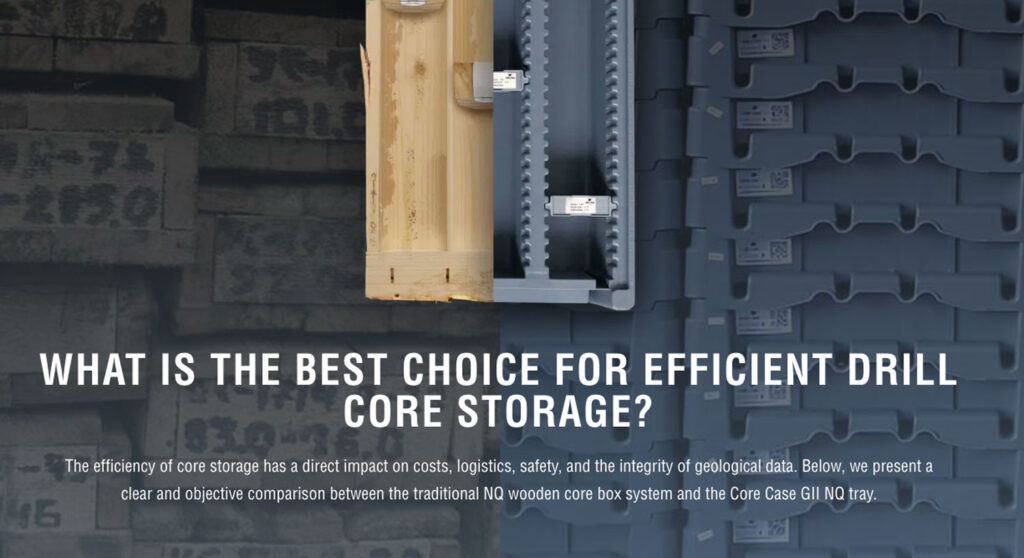
In Canada, many drilling operations still rely on wooden core boxes to store and ship drill core samples. That setup carries an often-overlooked cost driver: the lid. In the traditional model, crews typically work with a strict rule—one box requires one lid to keep ground and air transport secure. In other words, a 1:1 ratio. The outcome stays simple and expensive: as your box count grows, your lid count grows with it. You buy more lids, you store more lids, you handle more lids, and you ship more lids. Lids take up space, add weight, and increase operational complexity.
The issue isn’t “having a lid.” The issue is how the industry has gotten used to using the lid: in practice, it ends up behaving like a “second core box” inside the logistics flow. In Canada, wooden core boxes make this especially clear. To keep ground and air transport secure, many operations work with a strict 1:1 ratio — one lid per box — and that “lid” often functions like another box, which doubles shipped volume and the number of items teams must manage. To keep everything closed in transit, a common workaround is using a strap. It holds, but it adds steps, increases handling, and doesn’t always improve the experience once the box reaches inspection. In the end, what should be a direct process — close, ship, open, and analyze — becomes a sequence of adjustments, strapping, checks, and rework. And the critical point remains the same: teams need to remove the lid easily when they analyze samples later in the warehouse, without relying on improvised fixes that slow the workflow. As a result, the lid stops being simple protection and becomes a second inventory item, increasing material needs and storage footprint. In volume-driven operations — especially across long distances — that creates a compounding effect: more lids mean more shipped volume, more idle space, and more handling.

Core Case changes the logic by keeping the lid in its proper role: a cover—never a box. That approach lets you operate with a smarter standard: one lid for every 15 boxes. When you move from 1:1 to 1:15, you use up to 15x fewer lids for the same number of boxes. In percentage terms, that shift cuts lid requirements by about 93.33% (because 1 − (1/15) = 14/15 ≈ 0,9333 = 93,33%), when your operation can apply that ratio.
Even if you keep the same number of boxes, you eliminate the “extra” built into the system: lid volume drops sharply. That’s where efficiency becomes tangible. You coordinate fewer items, you take up less space, and you reduce handling across the workflow. In the end, you reduce steps, save time, and lower the chance of process failures—without changing what truly matters in the field: protecting the drill core samples, maintaining organization, and preserving transport integrity.

Every operation has its own math—routes, shipping frequency, how many boxes stay in rotation, the flow between field and base, and internal storage standards. That’s why you get the best outcome when you treat the ratio as a logistics design lever, not a generic number. can help you model your operation with real inputs, define how many lids you actually need, and quantify the impact on volume, complexity, and cost when you move away from the traditional model.
Want us to calculate this for your operation? Contact Core Case.